Open Preservation Community

    • Register
    • Login
    • Search
    • Categories
    • Recent
    • Tags
    • Popular
    • Users
    • Groups
    1. Home
    2. DuaneWAdams
    3. Posts
    D
    • Profile
    • Following 0
    • Followers 0
    • Topics 2
    • Posts 2
    • Best 0
    • Controversial 0
    • Groups 0

    Posts made by DuaneWAdams

    • How to Choose the Right Legal Structure for a New Company in Dubai?

      Starting a company in Dubai is an exciting decision, but it comes with one question that trips up almost every founder: which legal structure should you actually choose. Get this decision right and your company can operate smoothly, scale quickly, and stay fully compliant with UAE law. Get it wrong and you may face restricted market access, unnecessary costs, or even the need to restructure the entire company later on.
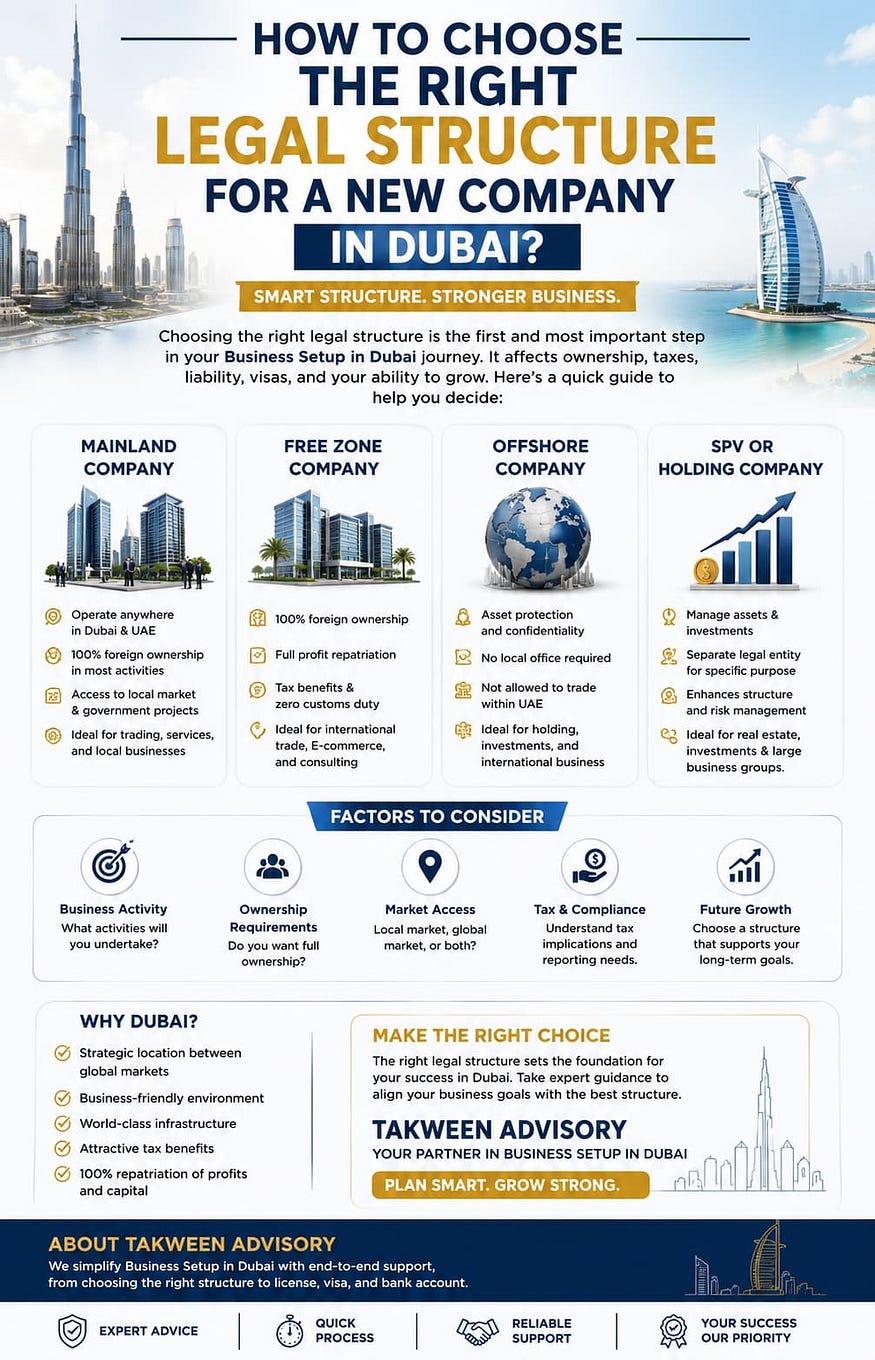
      How to Choose the Right Legal Structure for a New Company in Dubai — Takween Advisory

      This guide walks you through everything you need to know about business setup in Dubai, from the different legal structures available to the practical factors that should guide your final decision. Whether you are a solo entrepreneur, a small trading company, or an international investor exploring company formation in Dubai, this article will help you understand your options in plain, simple language.

      By the end of this article, you will understand the main legal structures available in Dubai, how ownership and taxation rules work, what documents and steps are involved, and how to avoid the common mistakes that catch new business owners off guard.

      Why the Legal Structure You Choose Matters So Much

      Every business in Dubai must operate under a specific legal structure that is registered with a licensing authority. This structure determines who can own the company, where it can legally trade, how it is taxed, how many visas it can sponsor, and what kind of banking and compliance obligations apply.

      Dubai is often described as a city of opportunity, and that reputation is well earned. It offers zero personal income tax, a relatively low corporate tax regime compared to many global markets, strong banking infrastructure, and a strategic location that connects Europe, Asia, and Africa. But none of these advantages work in your favor automatically. They only apply correctly when your business is set up under the right legal and jurisdictional framework from day one.

      Choosing the wrong structure is one of the most common and costly mistakes new entrepreneurs make. A business that plans to sell directly to walk-in customers across Dubai, for example, may find itself unable to do so if it is registered in a free zone that restricts direct mainland trading. Correcting this later often means additional paperwork, extra government fees, and lost time, so it pays to understand your options clearly before you begin.

      The Main Legal Structures Available in Dubai

      The Main Legal Structures Available in Dubai - Takween Advisory

      Dubai offers three broad categories of company formation, and within each category there are several specific legal forms depending on the number of owners, the nature of the activity, and the sponsoring authority.

      1. Mainland Company

      A mainland company is licensed by the Dubai Department of Economy and Tourism, commonly referred to as DET. This structure allows a business to trade freely anywhere in Dubai and across the wider UAE market, take on government contracts, and open branches in multiple emirates without additional licensing hurdles.

      Following amendments to the UAE Commercial Companies Law, most mainland business activities now allow full foreign ownership without requiring a local Emirati partner, although a narrow list of strategic sectors, such as those linked to national security or specific regulated industries, still require Emirati majority ownership or a local service agent. This shift has made mainland company formation in Dubai far more attractive to international entrepreneurs than it was in the past.

      Common mainland structures include:

      Limited Liability Company, suited to most trading, consulting, and service businesses with two or more shareholders

      Sole Establishment, suited to individual entrepreneurs offering professional or civil services

      Civil Company, used for licensed professionals such as consultants, doctors, engineers, and lawyers

      Branch of a Foreign or Local Company, used by companies expanding an existing legal entity into Dubai without creating a new one

      2. Free Zone Company

      Dubai has dozens of free zones, each generally focused on particular industries such as technology, media, logistics, finance, or manufacturing. Free zone companies benefit from full foreign ownership, streamlined registration processes, and in many cases zero percent corporate tax on qualifying income, provided the business meets the conditions to be treated as a Qualifying Free Zone Person under UAE corporate tax law.

      The tradeoff is that free zone companies are generally restricted from trading directly with the UAE mainland market unless they appoint a local distributor, open a mainland branch, or obtain a dual license where applicable. This makes free zones an excellent fit for export focused businesses, digital and technology companies, holding structures, and firms whose clients are mostly outside the UAE.

      Common free zone structures include:

      Free Zone Establishment, owned by a single shareholder

      Free Zone Company, owned by two or more shareholders

      Branch of an Existing Company, extending operations into a specific free zone

      3. Offshore Company

      An offshore company is a non resident legal entity typically used for holding assets, managing international investments, protecting intellectual property, or structuring cross border trade. Offshore companies cannot lease physical office space in the same way onshore entities do, cannot sponsor employee visas, and are not permitted to conduct business directly within the UAE market.

      Offshore structures are commonly used by holding companies, family offices, and international investors who want a stable, well regulated jurisdiction to hold shares, real estate, or other assets without needing a physical presence in Dubai. Offshore companies generally sit outside the standard UAE corporate tax net, since they are treated as non resident entities with no local operations, though each case should be reviewed individually with a tax professional.

      Comparing Mainland, Free Zone, and Offshore at a Glance

      Choosing between these three broad categories usually comes down to three questions: where do you want to trade, do you need to sponsor visas, and how important is full ownership and privacy to your business model.

      If your goal is to serve customers directly within Dubai and the wider UAE, including retail, government contracts, or walk-in service businesses, a mainland company is usually the right fit. If your business is export oriented, digital, or focused on international clients, a free zone company often provides a faster and more cost efficient path. If you are purely looking to hold assets, shares, or intellectual property without an operational presence in the UAE, an offshore structure is typically the most appropriate choice.

      Key Factors to Consider Before Choosing Your Legal Structure

      Key Factors to Consider Before Choosing Your Legal Structure - Takween Advisory

      Business Activity and Industry

      Every license in Dubai is tied to a specific business activity, and the activity you choose determines which authority regulates you and which jurisdiction is available to you. A logistics company, a media production house, and a financial consultancy will each be steered toward different free zones or mainland categories based on their core activity.

      Ownership Requirements

      If you want complete control of your company without a local partner, most free zone and many mainland activities now support full foreign ownership. However, a small number of strategic sectors still require Emirati participation, so it is worth confirming the ownership rules for your specific activity before committing to a structure.

      Market Access

      Ask yourself honestly where your customers are. A structure that limits you to international trade will not serve a business built around local UAE clients, and a mainland license may be more than you need if your entire customer base is overseas.

      Office Space and Physical Presence

      Mainland companies generally require a physical office that meets Ejari registration requirements. Free zones often offer flexible options ranging from shared desks and flexi-desks to dedicated offices and warehouses. Offshore companies, by contrast, do not require or permit a physical office in the same way.

      Visa Requirements

      The number of employee and investor visas you can sponsor is directly tied to your license type, office size, and jurisdiction. If you plan to build a sizeable team in Dubai, this should factor heavily into your choice of structure and facility size.

      Taxation and Compliance

      Under current UAE corporate tax rules, taxable income up to AED 375,000 is taxed at zero percent, with a 9 percent rate applying above that threshold. Businesses with total revenue at or below AED 3 million can, subject to conditions, elect Small Business Relief and be treated as having zero taxable income for that period. Free zone companies are not automatically tax exempt; they must meet a defined set of conditions, including maintaining real economic substance in the free zone, to qualify for the 0 percent rate on qualifying income. Every UAE business, regardless of its tax rate, is required to register with the Federal Tax Authority and file returns.

      Setup and Renewal Costs

      Costs vary considerably depending on business activity, license type, chosen jurisdiction, office requirements, visa quota, and approvals needed from specific government authorities. As a general guide, low cost business setup in Dubai through certain free zones can start from a modest annual license fee for a single activity with no visa allocation, while mainland licenses with office space and multiple visas typically involve higher combined costs once government fees, office rent, and visa charges are added together. These figures should be treated as indicative only, since Dubai business setup cost estimates change based on the specific package and authority involved.

      Step by Step Process to Choose and Register Your Legal Structure

      Step by Step Process to Choose and Register Your Legal Structure - Takween Advisory

      Working through this decision methodically makes the process far less overwhelming. Here is a practical sequence to follow.

      Step 1: Define your core business activity clearly, since this single decision shapes almost every other choice you make afterward.

      Step 2: Decide where your customers are based, so you can determine whether mainland, free zone, or offshore access suits your trading needs.

      Step 3: Assess your ownership and control preferences, and confirm whether your chosen activity allows full foreign ownership.

      Step 4: Shortlist two or three jurisdictions, whether that means DET for mainland or a small group of relevant free zones, and compare their fee structures and facility options.

      Step 5: Estimate your visa and office space needs based on your expected team size over the next twelve to twenty four months.

      Step 6: Request a formal quotation from a licensed business setup consultant so you understand the full picture of government fees, consultancy charges, and any third party costs involved.

      Step 7: Prepare your documentation, which typically includes passport copies, a business plan or activity description, and, for certain structures, a No Objection Certificate or additional approvals from sector specific regulators.

      Step 8: Submit your trade name reservation and initial approval application through the relevant authority.

      Step 9: Finalize your Memorandum of Association or equivalent incorporation documents, and settle the applicable license fees.

      Step 10: Complete post licensing steps, including opening a corporate bank account, registering for corporate tax with the Federal Tax Authority, and applying for any employee or investor visas you require.

      Real World Example: Choosing Between Free Zone and Mainland

      Consider a small e-commerce brand founded by two partners who plan to sell products online across the UAE and internationally, with the majority of revenue expected from regional online marketplaces rather than a physical shop. In this scenario, a free zone company focused on e-commerce or general trading activities is often the more practical starting point, since it supports full ownership, keeps initial costs manageable, and aligns well with an online, export oriented sales model.

      Now consider a catering company planning to supply corporate offices and host in-person events across Dubai. Because this business depends on direct, ongoing transactions with mainland clients, a mainland license under DET is generally the more suitable route, even though it may involve a higher initial cost than certain free zone packages.

      These examples illustrate why there is no single right answer for every business. The correct legal structure depends entirely on how, where, and to whom your company plans to sell.

      Pros and Cons of Each Structure

      Mainland Company

      Advantages include unrestricted access to the UAE market, eligibility for government contracts, and flexibility to open multiple branches across emirates. The main drawback is a generally higher setup and office cost compared to some free zone packages, along with mandatory Ejari-registered office space.

      Free Zone Company

      Advantages include full foreign ownership, streamlined registration, industry focused ecosystems, and potential access to the 0 percent qualifying income tax rate. The main drawback is restricted direct trading within the UAE mainland unless additional arrangements are made.

      Offshore Company

      Advantages include strong privacy, asset protection, and a straightforward structure for holding shares or property. The main drawback is that offshore companies cannot conduct commercial activity within the UAE or sponsor employee visas.

      Frequently Asked Questions

      What is the fastest legal structure to set up in Dubai?

      Many free zone company formations can be completed within a matter of days once documentation is complete, making them a popular choice for entrepreneurs who want to start operating quickly.

      Can a free zone company later convert to a mainland company?

      In many cases, yes. Businesses often start in a free zone and later add a mainland branch or fully migrate once their market access needs grow, though this involves separate licensing and approval steps.

      Do I need a local sponsor to own 100 percent of my Dubai company?

      For most business activities today, full foreign ownership is permitted under both mainland and free zone structures, though a limited number of strategic activities still require Emirati participation.

      Is business setup in Dubai expensive?

      Costs vary widely depending on business activity, license type, office requirements, and visa needs. Some free zone packages offer low cost business setup in Dubai for single activity licenses, while more complex mainland setups with larger office space and visa quotas cost more.

      Do free zone companies pay corporate tax?

      Free zone companies are not automatically exempt. They must meet specific conditions, including maintaining genuine economic substance, to qualify for the 0 percent rate on qualifying income, and non qualifying income is taxed at the standard 9 percent rate above the AED 375,000 threshold.

      Which structure is best for a small startup with a limited budget?

      Many early stage founders start with a free zone license because of its comparatively lower entry cost and full ownership benefits, then scale into a mainland presence once local demand justifies the additional investment.

      A Note on Costs, Fees, and Regulatory Changes

      Every cost mentioned in this article is indicative and intended purely as general guidance. Actual government fees, license charges, visa costs, and office rent depend on your specific business activity, chosen license type, jurisdiction, office space requirements, and any additional approvals required from government authorities. Government fees, regulations, and licensing policies in Dubai and the wider UAE can change over time without prior notice, so figures should always be reconfirmed before you budget or commit to a setup plan.

      It is also important to distinguish between official government charges and the fees charged by consultancy or professional service providers. Consultancy charges, professional service fees, and third party costs, such as those from PRO services, document clearance agents, or office space providers, are separate from government fees and can differ significantly between one service provider and another. For accurate, current pricing tailored to your specific business activity, it is best to speak directly with a licensed consultant rather than relying solely on published estimates.

      Conclusion

      Choosing the right legal structure is one of the most important decisions you will make during business setup in Dubai, and it deserves careful thought rather than a rushed guess. Mainland companies offer unrestricted access to the local market, free zone companies offer full ownership with strong cost efficiency for international and digital businesses, and offshore companies serve a very specific purpose around holding assets and protecting privacy. The right choice depends on your business activity, your target customers, your ownership preferences, and your budget for both government fees and professional support.

      If you are still weighing your options, working with experienced business setup consultants in Dubai can save you significant time, money, and stress. Takween Advisory specializes in guiding entrepreneurs and investors through every stage of company formation in Dubai, from selecting the most suitable jurisdiction and legal structure to handling licensing, visas, and ongoing compliance. The team at Takween Advisory can help you compare mainland, free zone, and offshore options side by side, request accurate and up to date quotations, and avoid the costly mistakes that come from choosing the wrong structure.

      If this guide helped clarify your next steps, share it with a fellow entrepreneur who is also exploring business setup services in UAE, leave a comment with your questions below, or reach out to Takween Advisory directly for a personalized consultation. Getting expert guidance early is one of the simplest ways to set your new Dubai company up for long term success.

      Thank you for reading this blog and learning more about free zone company setup in the UAE. A free zone company setup is an excellent option for entrepreneurs, startups, SMEs, and international investors seeking an efficient way to establish a business in one of the UAE's specialized economic zones. The setup process generally includes selecting the appropriate free zone, choosing the right business activity, determining the legal structure, reserving a trade name, preparing the incorporation documents, obtaining the required trade license, and completing company registration. Depending on the selected free zone and business requirements, additional steps may include opening a corporate bank account, applying for investor and employee visas, registering for corporate tax or VAT where applicable, and maintaining ongoing regulatory compliance. Careful planning, accurate documentation, and selecting the right jurisdiction are essential for a smooth incorporation process and sustainable business growth. Professional guidance helps investors compare free zone options, understand licensing requirements, and complete the registration process efficiently. If you are planning a free zone company setup in the UAE, visit the Takween Advisory website to explore expert company formation, banking assistance, visa services, trade licensing, corporate tax support, and business advisory solutions tailored to your business objectives.

      posted in Hackathon
      D
      DuaneWAdams
    • How Much Money Do You Require Minimum to Start a Business in Dubai?

      Dubai has firmly established itself as one of the world’s most business-friendly cities. With its world-class infrastructure, zero personal income tax, strategic location between East and West, and a thriving network of free zones, it is no surprise that thousands of entrepreneurs from around the globe choose Dubai as their launchpad every year.

      But one of the most common questions aspiring business owners ask is this — how much money do you actually need to start a business here? The honest answer is that it depends on several factors, including your chosen business activity, the type of license you require, whether you prefer a mainland or free zone setup, your visa needs, and the kind of office space you plan to use.

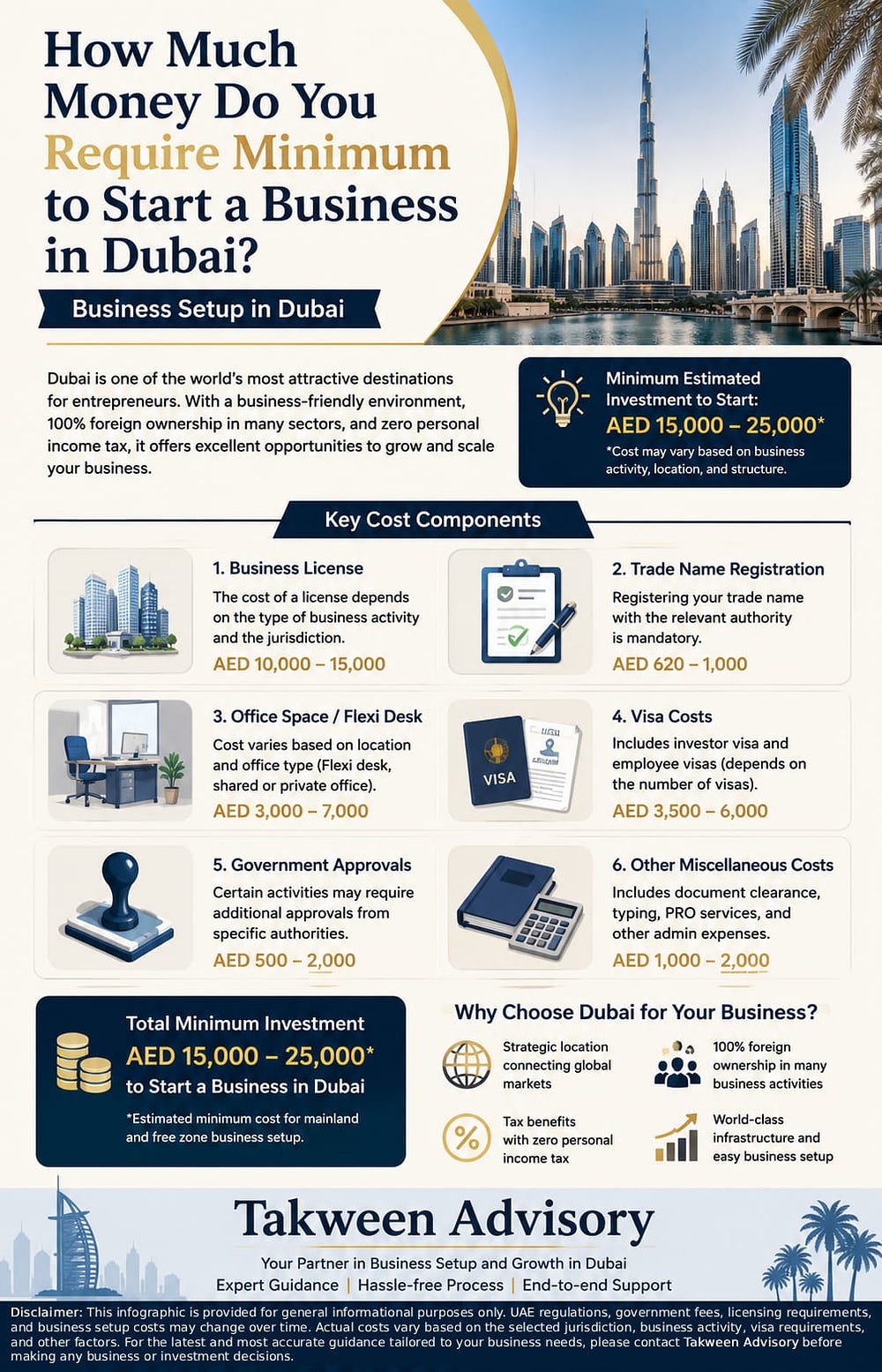
      How Much Money Do You Require Minimum to Start a Business in Dubai_ — Takween Advisory

      This guide breaks down everything you need to know about the minimum investment to start business in Dubai. From government fees to hidden costs, from free zone options to mainland requirements, we cover it all so you can plan your budget realistically and make informed decisions.

      Why Dubai Remains a Top Destination for Business Setup

      Before diving into costs, it helps to understand why Dubai continues to attract global entrepreneurs and investors. The UAE government has made significant strides in simplifying the business environment, reducing red tape, and introducing investor-friendly reforms that make the cost of setting up a company in Dubai genuinely competitive on a global scale.

      Key advantages include 100 percent foreign ownership now available in most mainland sectors following recent reforms, no corporate tax on qualifying small businesses under specific thresholds, no personal income tax, a highly stable political and economic environment, access to a diverse and skilled workforce, and world-class logistics and connectivity through Dubai International Airport and Jebel Ali Port.

      These factors make a low cost business setup in Dubai not just affordable, but genuinely rewarding in the long run.

      Key Factors That Affect the Cost of Starting a Business in Dubai

      The total investment you need is never a single fixed number. It varies based on a combination of factors. Understanding each one will help you calculate a realistic budget before you commit.

      Business Activity and License Type

      Business Activity and License Type — Takween Advisory

      Dubai classifies business licenses into three primary categories — commercial, professional, and industrial. A trading company operating in retail will have different cost implications compared to a consultancy offering professional services. Industrial licenses, which cover manufacturing activities, tend to involve higher setup costs due to facility and approval requirements. The nature of your activity directly determines which government departments must approve your application, and each adds its own fees.

      Jurisdiction — Mainland vs Free Zone vs Offshore

      This is arguably the most significant cost variable. Dubai offers three primary jurisdictions for business setup.

      • Mainland: Regulated by the Dubai Department of Economic Development (DED). Allows you to operate anywhere in the UAE and bid on government contracts.

      • Free Zone: Over 40 free zones in Dubai and the wider UAE, each tailored to specific industries. Offers 100 percent foreign ownership, full profit repatriation, and simplified setup procedures.

      • Offshore: Used primarily for holding companies, asset protection, and international operations. Not permitted to conduct business inside the UAE market.

      Each jurisdiction comes with a different cost structure, regulatory framework, and set of business benefits.

      Visa Requirements

      Visa Requirements - Takween Advisory

      Every business license in Dubai comes with a certain number of visa allocations. The number of visas you require — for yourself, your partners, and your employees — directly increases your total setup cost. Each visa involves medical testing, Emirates ID registration, and stamping fees. If you plan to sponsor family members as well, this adds further to the budget.

      Office Space Requirements

      Mainland licenses typically require a physical office lease as a prerequisite for license issuance. Free zones, on the other hand, offer flexi-desk or shared workspace options that can significantly reduce overhead. Some free zones even offer virtual office packages that include a registered address, which suits online businesses and consultants looking to minimise costs.

      Cost Breakdown — What You Can Expect to Pay

      It is important to note upfront that all cost figures in this section are estimates based on commonly available information and standard market conditions. Actual costs may vary depending on your specific business activity, chosen free zone or mainland authority, visa count, office type, government approvals required, and professional service fees. Government fees, regulations, and policies are subject to change at any time without prior notice. Always consult a licensed business setup consultant for current and accurate pricing.

      Mainland Business Setup in Dubai

      Setting up a mainland company through the Dubai Department of Economic Development involves several cost components. These typically include trade name reservation, initial approval fees, memorandum of association drafting and notarisation, license issuance fees, establishment card fees, and office lease costs. Additional costs arise if your business requires approvals from sector-specific authorities such as the Dubai Health Authority, Dubai Municipality, or the Real Estate Regulatory Agency.

      Mainland setups are generally suited for businesses that want to operate across the UAE without geographic restrictions, deal with local government entities, or require a retail presence within Dubai.

      Free Zone Business Setup in Dubai

      Free zones are often the most cost-effective starting point for entrepreneurs looking to start a business in Dubai with low investment. Each free zone has its own fee schedule, but many have developed affordable packages, particularly for freelancers, startups, and small businesses.

      Some of the most popular free zones for affordable business setup include IFZA (International Free Zone Authority), SHAMS (Sharjah Media City, which is popular with Dubai-based entrepreneurs), RAKEZ (Ras Al Khaimah Economic Zone), and Meydan Free Zone. These offer competitive entry-level packages that bundle the license, a flexi-desk or virtual office, and in some cases, one visa entitlement.

      Costs within free zones will vary based on the activity category, the number of visas required, and the type of office space selected. It is worth comparing multiple free zones to find the one that best aligns with your activity and budget.

      Offshore Company Setup in Dubai

      Offshore setups are typically used by investors and international businesses that do not need a physical presence inside the UAE market. Popular offshore jurisdictions in the UAE include JAFZA (Jebel Ali Free Zone Offshore) and RAKICC (Ras Al Khaimah International Corporate Centre). Costs here are generally lower than mainland or operating free zone companies, since there are no visa or office space requirements.

      Step-by-Step Process to Set Up a Business in Dubai

      Step-by-Step Process to Set Up a Business in Dubai — Takween Advisory

      Whether you choose mainland or free zone, the setup process follows a structured sequence. Here is a general overview.

      Step 1: Determine your business activity and the appropriate license type. This is the foundation of your setup and affects every subsequent decision.

      Step 2: Choose your jurisdiction. Decide whether a mainland, free zone, or offshore structure best suits your business model, operational needs, and target market.

      Step 3: Select your company structure. Options include sole proprietorship, limited liability company (LLC), civil company, branch of a foreign company, or free zone establishment (FZE) and free zone company (FZC).

      Step 4: Reserve your trade name. The trade name must comply with UAE naming conventions and be unique within the chosen jurisdiction.

      Step 5: Obtain initial approval. This is a preliminary clearance from the relevant authority confirming that your business activity is permissible.

      Step 6: Secure your office space. Depending on your jurisdiction, this could be a formal lease, a flexi-desk, or a virtual office arrangement.

      Step 7: Submit your application and required documents. These typically include passport copies, visa page copies, proposed trade name, business activity details, and for mainland — a notarised memorandum of association.

      Step 8: Pay the relevant government fees and collect your trade license. Once issued, your license allows you to operate legally within the permitted scope.

      Step 9: Apply for your residency visa and Emirates ID. This step is essential for establishing your legal residency in the UAE.

      Step 10: Open a corporate bank account. Most UAE banks require a valid trade license, Emirates ID, and proof of business address before opening an account.

      Hidden and Often Overlooked Costs in Business Setup

      Many first-time entrepreneurs focus only on the license fee and are caught off guard by additional costs that arise during the setup process. Being aware of these in advance will help you plan a more accurate budget.

      • Consultancy and professional service fees charged by business setup firms — these are usually separate from official government charges and vary between service providers.

      • PRO (Public Relations Officer) services for document attestation, translation, and government liaison.

      • Document attestation fees, particularly for educational certificates or foreign documents that require notarisation or MOFA attestation.

      • Bank account opening charges and minimum balance requirements, which differ significantly between banks.

      • Accounting and bookkeeping costs to comply with UAE Corporate Tax regulations introduced in June 2023.

      • VAT registration if your annual turnover exceeds or is expected to exceed AED 375,000.

      • License renewal costs on an annual basis.

      Most Affordable Business Setup Options in Dubai

      Most Affordable Business Setup Options in Dubai - Takween Advisory

      For entrepreneurs specifically seeking a low cost business setup in Dubai, the following options consistently rank among the most budget-friendly.

      Freelance Permit

      Individuals providing independent professional services can obtain a freelance permit through several free zones in Dubai and the wider UAE. This is one of the most economical entry points for solo practitioners in creative, technology, consulting, and media industries. It grants a legal work permit and residency eligibility without the overhead of a full company structure.

      Single-Activity Free Zone License with Virtual Office

      Choosing a single permitted activity, pairing it with a virtual office or flexi-desk, and limiting your initial visa count to one or two is a proven strategy for minimising startup costs in a free zone environment. Many entrepreneurs start with this model and expand their setup as their business grows.

      Home-Based Business License (Dubai Economy)

      Dubai Economy, the trade name for the Dubai Department of Economic Development, offers a home-based business license for entrepreneurs who can operate from their residential address. This eliminates the cost of renting commercial office space, making it one of the most accessible routes for eligible activities such as private tutoring, online retail, and small-scale crafts.

      Recent Reforms That Make Business Setup More Accessible

      The UAE government has introduced a series of landmark reforms over recent years that have made starting a business more accessible and affordable than ever before.

      The amendment to the UAE Commercial Companies Law in 2021 removed the mandatory requirement for a local sponsor or local service agent for most mainland business categories, now permitting 100 percent foreign ownership. This eliminated a significant cost and structural complexity that previously deterred many foreign investors from choosing mainland over free zones.

      The introduction of the Corporate Tax regime, effective June 2023, set a zero percent rate for businesses earning annual taxable income up to AED 375,000, ensuring that small businesses and startups are largely protected from direct tax obligations in their early years.

      The UAE Golden Visa and Green Visa programmes have also made long-term residency more attainable for investors and entrepreneurs, adding further stability for those building businesses in Dubai.

      Real-Life Scenarios — What Different Entrepreneurs Typically Spend

      To give you a practical sense of how costs play out, here are three illustrative scenarios based on commonly reported experiences. Please note these are indicative examples only and actual costs will vary.

      Scenario A — A Digital Marketing Consultant Starting Lean

      A solo consultant who wants to offer digital marketing services to clients outside the UAE might opt for a free zone license with a virtual office and a single visa. This keeps the upfront investment relatively low and avoids the need for commercial rental. The main cost components are the free zone license fee, the virtual office subscription, visa and Emirates ID processing, and medical fitness testing. A business setup consultancy fee may apply separately.

      Scenario B — A Trading Company Targeting the UAE Market

      An entrepreneur who wants to import goods and sell them within the UAE market will typically need a mainland trading license. This requires a physical office lease and approval from the DED. The cost structure here is higher due to office rental, memorandum of association notarisation, and in some cases, additional approvals from Dubai Municipality or Customs. Multiple visas for staff will increase the overall budget further.

      Scenario C — A Technology Startup in a Dedicated Tech Free Zone

      A technology startup looking to benefit from a community of like-minded businesses and access to incubation programmes might choose a tech-focused free zone such as Dubai Internet City (DIC) or Dubai Silicon Oasis (DSO). These zones offer startup-friendly packages but may come at a premium compared to more general-purpose free zones. The tradeoff is access to networking, credibility, and a tech ecosystem.

      Pros and Cons of Starting a Business in Dubai

      Advantages

      • Strategic geographic location bridging Europe, Asia, and Africa.

      • Zero personal income tax and competitive corporate tax structure.

      • 100 percent foreign ownership available in most sectors.

      • Full repatriation of capital and profits.

      • Robust infrastructure, banking, and legal framework.

      • Wide range of affordable free zone options suitable for startups and SMEs.

      Considerations and Challenges

      • Setup costs can escalate if visa requirements are high or office space is underestimated.

      • Annual license renewal costs must be factored into long-term financial planning.

      • Banking procedures can be lengthy; some businesses face challenges opening accounts depending on their activity.

      • Compliance with UAE Corporate Tax and VAT regulations requires accounting support.

      • Free zone businesses generally cannot trade directly with the UAE mainland without a distribution arrangement or local agent.

      Important Disclaimer Regarding Business Setup Costs in Dubai

      All cost references in this article are indicative estimates and are provided for general information purposes only. Actual government fees, regulatory requirements, and processing timelines may change at any time without prior notice. Business setup costs in Dubai are influenced by your specific activity, license type, chosen jurisdiction, number of visas, office space category, and the nature of government approvals required.

      Consultancy and professional service fees charged by third-party business setup providers are entirely separate from official government charges and will differ between service providers. Third-party costs such as accounting services, legal fees, document attestation, PRO services, and bank charges are also not included in standard government fee schedules.

      We strongly encourage all prospective business owners to consult a qualified and licensed business setup consultant in Dubai to obtain accurate, up-to-date, and personalised cost estimates before making any financial commitment.

      Frequently Asked Questions

      What is the minimum investment required to start a business in Dubai?

      There is no single universal minimum investment figure as costs depend on your business activity, chosen jurisdiction (mainland or free zone), visa requirements, and office type. Free zone setups with a virtual office and a single activity tend to represent the most affordable entry point. A business setup consultant can provide a tailored cost estimate based on your specific requirements.

      Can a foreigner own 100 percent of a company in Dubai?

      Yes. Following the 2021 amendment to the UAE Commercial Companies Law, 100 percent foreign ownership is permitted for most business activities on the mainland. Free zones have always offered full foreign ownership.

      Is a free zone business allowed to operate in the Dubai mainland market?

      In most cases, free zone companies are not permitted to trade directly with the UAE mainland market without engaging a mainland distributor or obtaining a mainland license. However, they can freely trade internationally and with other free zone entities.

      How long does it take to set up a company in Dubai?

      The timeline varies between a few working days for straightforward free zone setups to several weeks for mainland companies requiring multiple regulatory approvals. Having a professional business setup consultant manage the process can significantly reduce the turnaround time.

      Do I need an office to start a business in Dubai?

      Mainland licenses generally require a physical office lease. Free zones typically offer flexi-desk, shared workspace, or virtual office options that are more cost-effective. The requirement depends on your jurisdiction and the nature of your business activity.

      Is Dubai a good place for small businesses and startups?

      Absolutely. Dubai’s ecosystem supports small businesses and startups through affordable free zone packages, government-backed innovation initiatives, access to a large consumer market, and a tax-friendly environment. The low cost business setup in Dubai makes it highly accessible even for entrepreneurs with limited initial capital.

      Conclusion: Your Next Step Toward a Successful Business in Dubai

      Starting a business in Dubai is more accessible than many entrepreneurs realise. Whether you are a solo consultant, a small trading company, or a growing technology startup, there is a setup structure designed to fit your budget and your goals. From flexible free zone packages to mainland options with full market access, the path to business ownership in Dubai is well-paved and clearly defined.

      Understanding that a low cost business setup in Dubai is achievable is just the first step. The key to success lies in choosing the right jurisdiction, structuring your company correctly from the start, and working with an experienced consultancy that understands the nuances of the UAE regulatory landscape. When you start a business in Dubai with low investment, every dirham saved on unnecessary costs is a dirham reinvested into growing your business. This is precisely where Takween Advisory comes in.

      How Takween Advisory Can Help You Set Up Your Business in Dubai

      Takween Advisory is a trusted business setup consultancy in Dubai, dedicated to helping entrepreneurs, investors, and SMEs navigate the company formation process with confidence and clarity. Our team of experienced professionals provides end-to-end support — from choosing the right jurisdiction and activity to license registration, visa processing, corporate banking, and ongoing compliance.

      We understand that every business is unique. That is why we offer personalised consultations to help you understand the true cost of setting up a company in Dubai, avoid unexpected expenses, and make the most of available opportunities within your budget. Whether you are exploring mainland or free zone options, Takween Advisory brings local expertise and transparent pricing to every client engagement.

      Ready to take the first step? Contact Takween Advisory today for a free consultation. Let us build your business in Dubai the right way — efficiently, cost-effectively, and with complete peace of mind. Share this article with someone who is planning to start their business journey in Dubai, leave a comment with your questions, or reach out to our team directly to get personalised guidance tailored to your vision.

      Disclaimer: The information provided in this article is for general guidance only and may not reflect the latest UAE regulations, government fees, or licensing requirements. Business setup costs vary depending on the chosen jurisdiction, business activity, visa requirements, and other factors. For accurate, up-to-date, and business-specific advice, please contact Takween Advisory before making any business or investment decisions.

      Thank you for reading this blog and searching for business setup consultancy in Dubai. A business setup consultancy in Dubai helps entrepreneurs, startups, SMEs, and international investors establish their companies efficiently while ensuring full compliance with UAE regulations. Professional consultants provide expert guidance on selecting the right business activity, choosing the most suitable legal structure such as mainland, free zone, or offshore, obtaining trade licenses, processing visas, opening corporate bank accounts, and managing regulatory requirements. Business setup consultants simplify complex procedures, reduce administrative burdens, and help businesses avoid costly delays or compliance issues. Whether you are launching a new venture, expanding into the UAE market, or restructuring an existing business, a reliable consultancy can provide tailored solutions based on your objectives and industry requirements. With expert support and local market knowledge, businesses can complete the setup process smoothly and focus on growth opportunities in Dubai’s dynamic and competitive business environment.

      posted in Hackathon
      D
      DuaneWAdams